Stories / The Case-Book of Sherlock Holmes · 1926
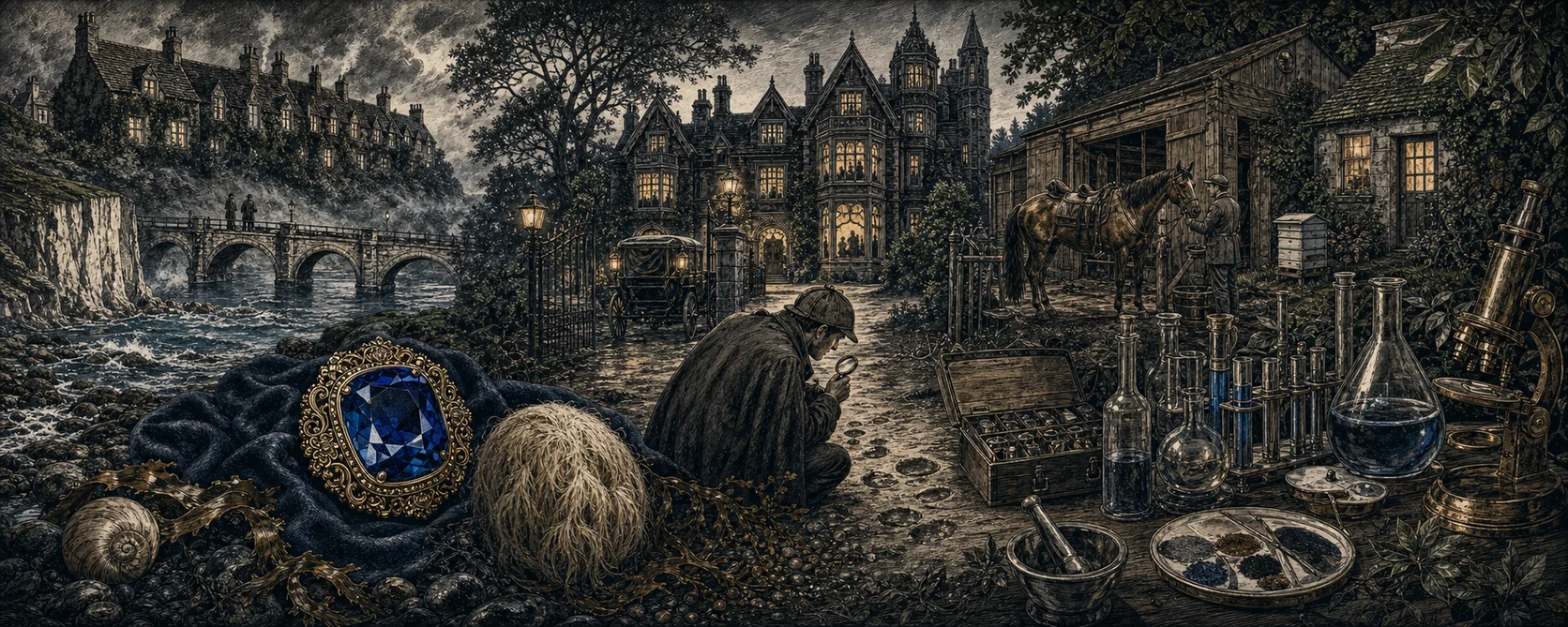
The Adventure of the Blanched Soldier
Holmes narrates for once: a soldier glimpsed chalk-white at a window is thought a leper — elimination and a dermatologist restore him to the living.
✅ Public domain — read, share, and adapt freely.
⚠️ Spoilers below. The analysis discusses the solution, including who did it and how it's found out.
Summary & analysis
Narrated by Holmes himself in Watson's absence: a soldier seeks his vanished war-comrade Godfrey Emsworth, glimpsed once at a window with a face bleached ghastly white and then hidden away by his family in an out-building.
Holmes reads the family's evasions and the geography of the estate, weighing the theories a white face and secrecy suggest — imprisonment, shame, disease — and narrowing by what the physical arrangements do and do not permit.
Godfrey believed he had contracted leprosy in a South African hospital and hid himself to spare his family; a specialist Holmes summons diagnoses pseudo-leprosy — a curable mimic. Elimination of the dreaded diagnosis restores a man the household had already buried alive.
Deeper reading
Holmes tells his own story
The Blanched Soldier is one of only two tales narrated by Holmes himself, and he uses the chance to grumble at how much harder it is to tell a case well than to solve it — a wry authorial joke from Doyle. The mystery, a soldier hidden away and feared a leper, is solved by elimination and a dermatologist\'s reassurance.
Fear worse than the truth
The story\'s kindness is its point: the dreaded diagnosis is wrong, and the isolation was self-imposed terror. It belongs to the canon\'s humane strain, where the frightening surface hides a treatable, human truth — and where Holmes\'s reasoning restores a life rather than ending one.
Techniques on display
Elimination
Striking out the impossible until the truth remains.
In this story: Holmes lists what a hidden, blanched man could be and strikes the impossibilities until disease leads — then insists the specific disease itself be verified rather than assumed.
Deduction & inference
Chaining evidence into conclusions on a living board.
In this story: The out-building's comforts and the family's grief-not-shame tell Holmes the man is protected, not punished — the arrangements read as quarantine, pointing to illness.
Practise what this story preaches: every technique above links to a tool or game built on the same method. The best way to learn the canon is to reason along with it.