Stories / The Case-Book of Sherlock Holmes · 1926
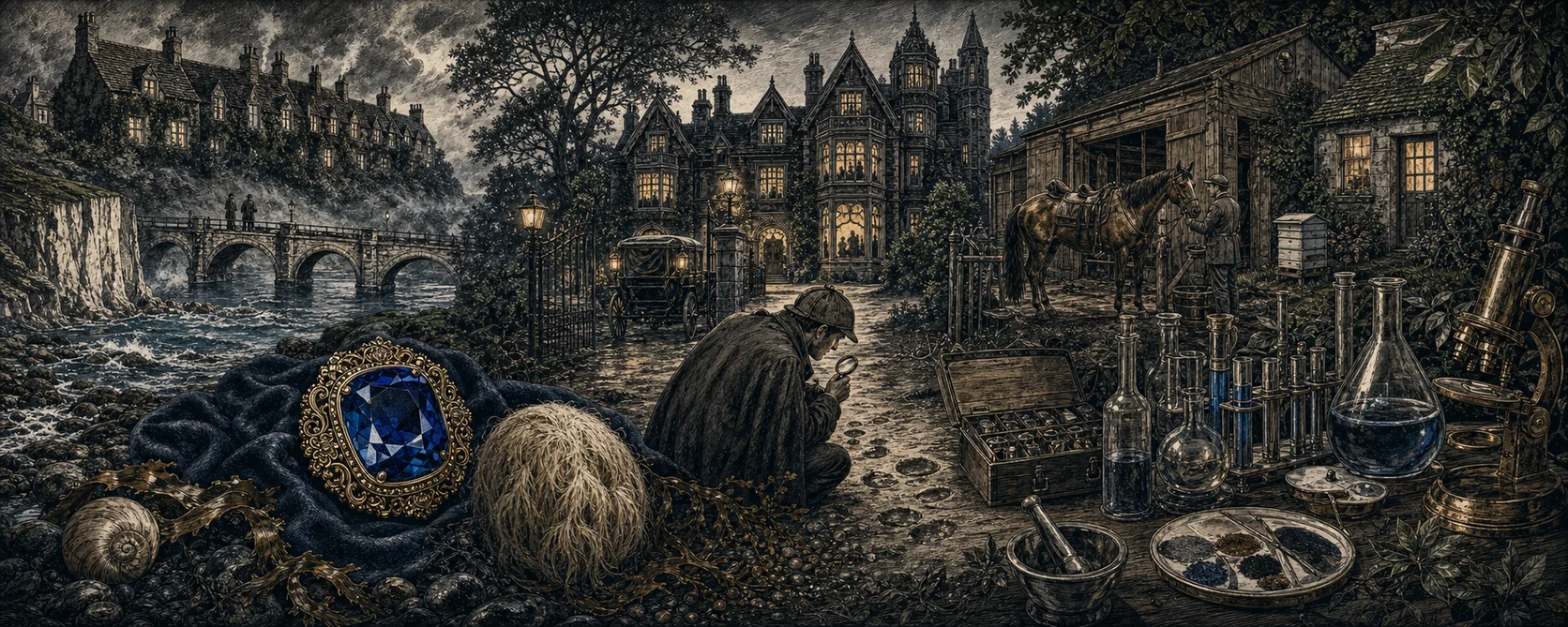
The Adventure of the Retired Colourman
A miser's young wife elopes with his chess partner — into a sealed strong-room smelling of paint; the smell, and a ticket stub, hang him.
✅ Public domain — read, share, and adapt freely.
⚠️ Spoilers below. The analysis discusses the solution, including who did it and how it's found out.
The Adventure of the Retired Colourman summary & analysis
An old paint-manufacturer, Josiah Amberley, hires Holmes to find his young wife, who has fled with his chess-partner and his savings; the wronged husband seems a figure of pity — miserly, jealous, and abandoned.
Watson is sent to the house and reports; Holmes fixes on wrong notes — a freshly painted room reeking to hide another smell, a strong-room that seals airtight, and a theatre-ticket alibi that inquiry shows the husband never used. The victim's story does not survive checking.
Amberley himself murdered the pair and gassed them in his sealed strong-room, then painted over the evidence and invented the elopement, even hiring Holmes to gild his innocence. The paint-smell cover and the false alibi convict him — the client was the killer all along.
Deeper reading
A smell that hangs a man
The Retired Colourman resolves on the sense the canon rarely uses — Holmes catches a killer through the smell of fresh paint used to mask a gas leak in a sealed strong-room, where a jealous husband entombed his young wife and her lover. It is a grim, tightly built late case with a genuinely nasty crime at its centre.
The detective's melancholy
The story ends on one of Holmes\'s bleak reflections on the futility and misery of the human record — the late canon\'s recurring darkening of tone. Beneath the clever solution is a sour study of possessive jealousy, and a Holmes who solves the crime without any joy in it.
Play this story
Free, built on this case's own facts — no sign-up, nothing to install.
Techniques on display
Observation
Reading occupation, history, and character from visible detail.
In this story: The reek of fresh paint where none was needed is the tell: a man hiding one smell beneath another, and an airtight strong-room that doubles as a gas chamber.
Elimination
Striking out the impossible until the truth remains.
In this story: The husband's theatre alibi collapses under a simple check — he was never in his seat — eliminating the wronged-victim story and turning the client into the suspect.
Deduction & inference
Chaining evidence into conclusions on a living board.
In this story: Hiring a detective to certify one's own innocence is itself suspicious; Holmes reads the over-performance of grievance as the guilty man's gilding.
Practise what this story preaches: every technique above links to a tool or game built on the same method. The best way to learn the canon is to reason along with it.