Stories / The Adventures of Sherlock Holmes · 1892
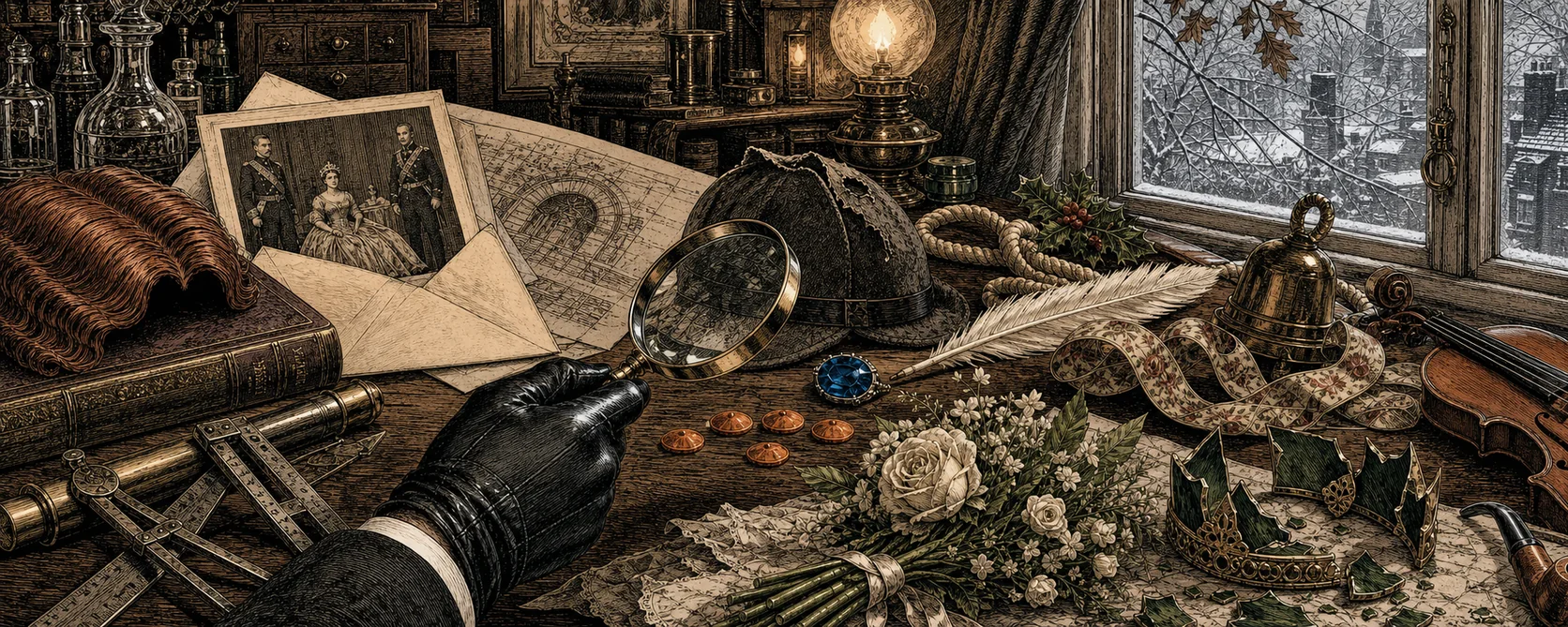
The Adventure of the Copper Beeches
A governess is paid too well to cut her hair and sit in a window; she is a living decoy for an imprisoned daughter.
✅ Public domain — read, share, and adapt freely.
⚠️ Spoilers below. The analysis discusses the solution, including who did it and how it's found out.
The Adventure of the Copper Beeches summary & analysis
Violet Hunter consults on an ethical instinct: a governess post at over-market wages, conditioned on cutting her hair, wearing a given dress, and sitting in a window on command. Holmes tells her to keep him within telegram reach — the fee measures the falseness.
At the Copper Beeches the duties resolve into theatre: the electric-blue dress, the laughing-at-nothing sessions with her back to the road, a man watching from the lane, a locked wing, and a starved mastiff loosed at night. A mirror shard in a handkerchief lets her see the audience.
Miss Hunter is a stand-in for the imprisoned daughter Alice, whose suitor must be convinced she is free and indifferent; the rescue finds the cell empty — Rucastle assumed betrayal — and the mastiff turns on its keeper. The daughter is already safe with her suitor; the decoy testifies.
Deeper reading
The client as detective
The Copper Beeches gives us the canon\'s best client-observer in Violet Hunter, a governess whose careful reporting — the enforced dress, the seat by the window, the hair kept in a drawer — is detailed enough that Holmes half-solves the case from her narrative. Doyle plainly admires her nerve and intelligence; Holmes\'s regret that she is not a relation he could advise is a rare warm note.
Menace behind the country idyll
The story voices one of the canon\'s darker themes directly: Holmes\'s shudder at the lonely houses of the countryside, where cruelty can hide unseen. Beneath the mystery of the paid impersonation lies real domestic imprisonment, and the tale trades the reassurance of the city for the isolation where the law cannot easily reach.
Play this story
Free, built on this case's own facts — no sign-up, nothing to install.
Techniques on display
Observation
Reading occupation, history, and character from visible detail.
In this story: Miss Hunter is the canon's best client-observer: she reports the dress, the seating angle, the laughter scripts, and the hair coil in a drawer — data enough that Holmes solves from her narrative.
Deduction & inference
Chaining evidence into conclusions on a living board.
In this story: Overpayment is treated as a measurable signal: wages minus market equals the price of something a governess would refuse — Holmes solves for the refusal.
Disguise & misdirection
Seeing through appearances built to deceive.
In this story: The imposture is inverted: the disguise is worn innocently by the victim's double, and reading it means asking who benefits from the performance's audience.
Practise: 🚨 Lestrade's Lineup Practise: 👁️ The Science of Deduction
Practise what this story preaches: every technique above links to a tool or game built on the same method. The best way to learn the canon is to reason along with it.