Stories / The Return of Sherlock Holmes · 1903
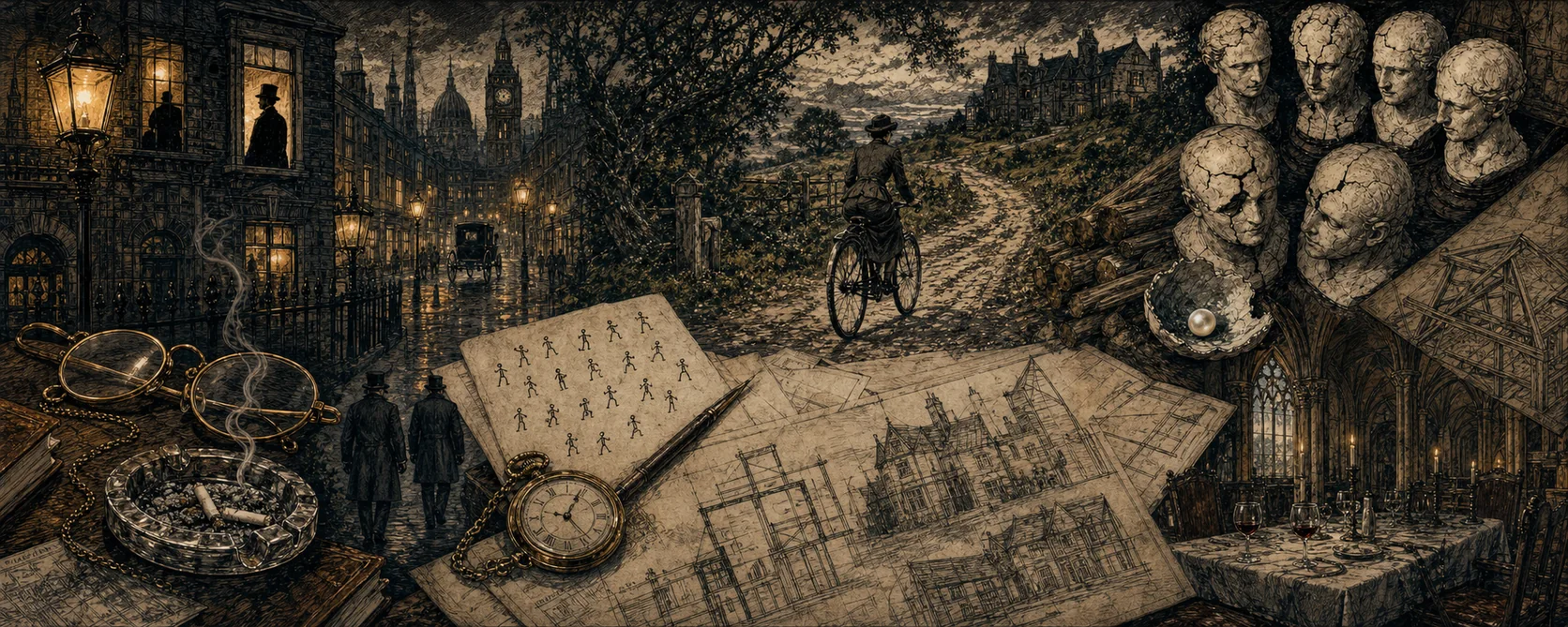
The Adventure of the Norwood Builder
A young solicitor inherits from a client found burned the same night; a thumbprint that appears overnight proves too much, and a smoke-out finds the living corpse.
✅ Public domain — read, share, and adapt freely.
⚠️ Spoilers below. The analysis discusses the solution, including who did it and how it's found out.
Summary & analysis
A frantic young solicitor, John Hector McFarlane, is arrested almost mid-sentence: the builder Jonas Oldacre made him sole heir and was burned to bones the same night, McFarlane's stick and prints at the scene — a case the police consider closed on arrival.
Holmes distrusts the perfection of the evidence: a will drafted on a train (jolts in the script), a burned woodpile with the wrong remains, a vanished man with a grudge and a hidden bank balance. Then a bloody thumbprint appears on a wall that was bare the day before — too much proof.
The over-egged thumbprint betrays the frame: Oldacre faked his own murder to ruin the son of the woman who once refused him, hiding in a walled-off passage. Holmes smokes him out — literally, a cry of fire — and the living corpse bolts from the wall he was hiding behind.
Deeper reading
A clue that proves too much
The Norwood Builder turns on a beautiful inversion: a bloody thumb-print that appears overnight is not evidence of guilt but proof of a frame, because it was not there the day before. Doyle, writing fingerprints into detection while the real Yard still argued about them, shows the method\'s sophistication — an over-perfect clue is itself a clue. The smoke-out that flushes the living "victim" from his hiding place is a fine theatrical finish.
Reasoning against the tide
The story is a strong showcase of Holmes holding a conclusion against all circumstantial pressure: the young solicitor is doomed by appearances, and Holmes alone reads the appearances as manufactured. It is the canon\'s recurring drama of the trained mind refusing the obvious story — the same instinct our Eliminate the Impossible tool is built to train.
Play this story
Free, built on this case's own facts — no sign-up, nothing to install.
Techniques on display
Elimination
Striking out the impossible until the truth remains.
In this story: The bone analysis kills the murder theory: the woodpile's remains lack a human skeleton's markers, so 'Oldacre' cannot be dead — and a man not dead is a man hiding.
Argument & fallacy
Untangling claims, premises, and the flaws between them.
In this story: The thumbprint is the fallacy of the gilded lily: evidence that appears after Holmes has already seen the clean wall proves manufacture — a frame betrayed by its own eagerness.
Practise what this story preaches: every technique above links to a tool or game built on the same method. The best way to learn the canon is to reason along with it.