Stories / The Return of Sherlock Holmes · 1903
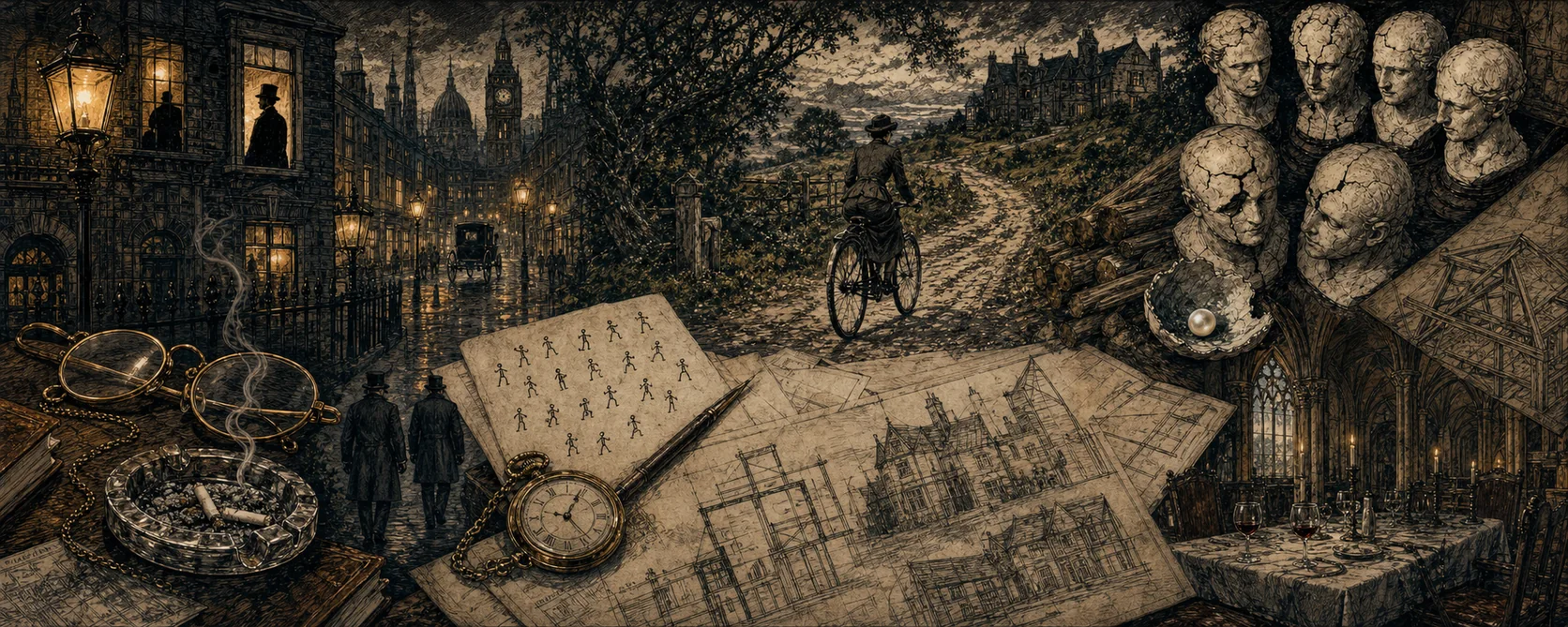
The Adventure of the Dancing Men
Chalked stick-figures terrorise a Norfolk wife; Holmes breaks the substitution cipher by letter frequency — and answers in the same dancing hand.
✅ Public domain — read, share, and adapt freely.
⚠️ Spoilers below. The analysis discusses the solution, including who did it and how it's found out.
The Adventure of the Dancing Men summary & analysis
Hilton Cubitt brings his wife's terror in the form of chalked stick-figures appearing on his Norfolk windowsills and sundial; Elsie, American and secretive, begged him never to ask about her past, and now the little dancing men are driving her to collapse.
Holmes attacks the figures as a substitution cipher: the commonest symbol must be E, flag-bearing figures end words, and short repeated groups suggest a name — 'ELSIE'. Message by message he cracks the alphabet even as the cipher demands she 'come' — and he races a reply too late.
Abe Slaney, Chicago gunman and Elsie's old betrothed, shoots Cubitt before Holmes arrives; Holmes lures him with a message written in the very dancing hand, and Slaney walks in thinking Elsie has summoned him. Frequency analysis both solves the murder and baits the trap.
Deeper reading
A cipher you can actually solve
The Dancing Men is the canon\'s great cryptographic story, and its pleasure is that the code is real: a substitution cipher of stick figures, broken by frequency analysis exactly as Holmes describes. Doyle turns cryptanalysis into drama, and the childish-looking glyphs into a genuine death threat. The cipher has since become one of the most recognisable images in all of Holmes — playable on this site in the Cipher Bureau.
A rare tragic failure
For all Holmes\'s brilliance, he arrives too late to save his client, and the story carries a sombre weight beneath its ingenuity. His final flourish — answering the killer in the same dancing hand to lure him in — is detection turned to the trap, but it cannot undo the death. It is a reminder that the canon\'s cleverest stories are often its saddest.
Play this story
Free, built on this case's own facts — no sign-up, nothing to install.
Dancing Men Cipher Bureau
Secret messages in the famous stick-figure cipher, plus Caesar (with a cracker), Vigenère, and Atbash — instant, in your browser.
Open the tool →Cipher Sprint
Sixty seconds, dancing men marching in — decode as many words as you can before the clock runs out.
Open the tool →The Fifth Message
Decode the last dancing-men message left at Ridling Thorpe — the one that arrived before the shots.
Play the game →The Substitution Drill
Train the method that broke the dancing men: shift, count, and read.
Open the tool →Techniques on display
Ciphers & codes
Secret writing broken by frequency and pattern.
In this story: The canonical frequency attack: assume the most frequent glyph is E, use flag-markers as word-ends, seed known words like the wife's name, and expand until the alphabet falls.
Practise: 💃 Dancing Men Cipher Bureau Practise: 📖 Porlock's Book Cipher Practise: ⏱️ Cipher Sprint
Deduction & inference
Chaining evidence into conclusions on a living board.
In this story: Holmes closes the case by writing in the enemy's cipher — proof of solution turned into an instrument, summoning the killer with his own code.
Practise what this story preaches: every technique above links to a tool or game built on the same method. The best way to learn the canon is to reason along with it.