Stories / The Return of Sherlock Holmes · 1904
The Adventure of the Six Napoleons
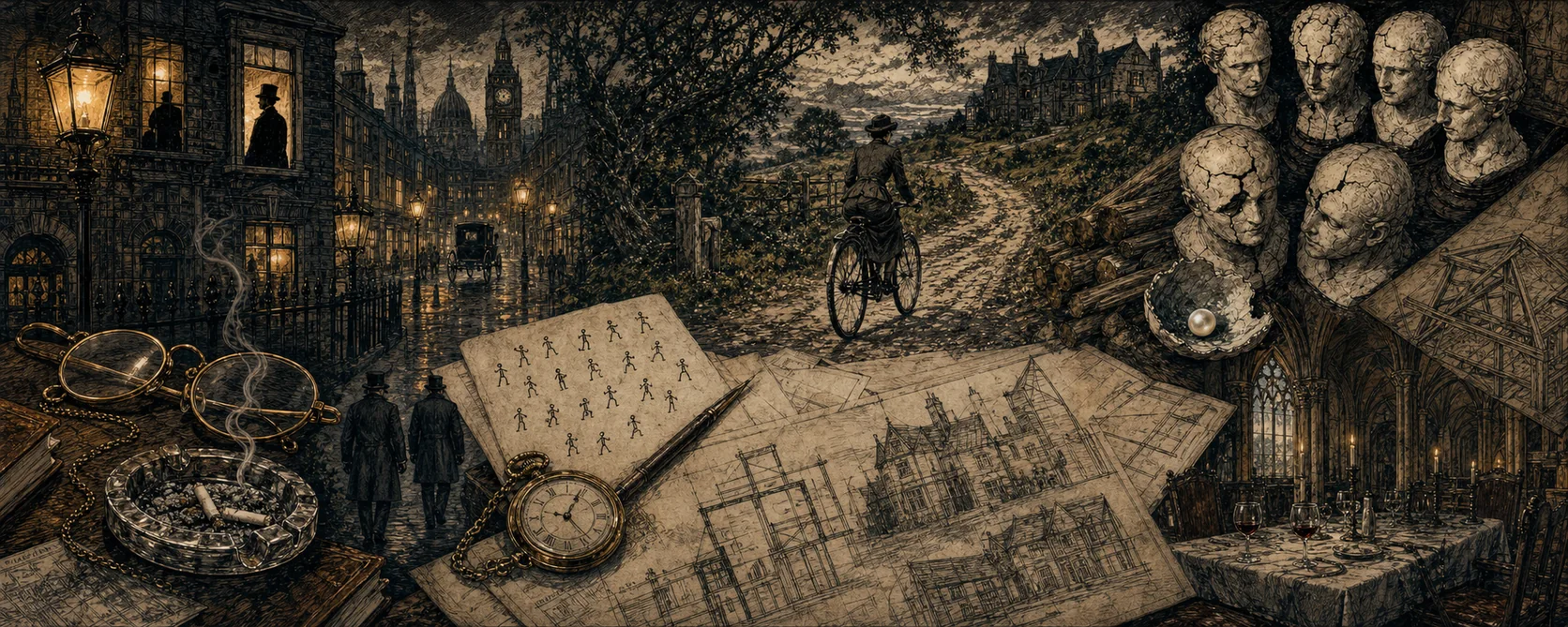
Someone is smashing plaster busts of Napoleon across London; the sixth holds the black pearl of the Borgias — pattern, not madness.
✅ Public domain — read, share, and adapt freely.
⚠️ Spoilers below. The analysis discusses the solution, including who did it and how it's found out.
Summary & analysis
A vandal is smashing cheap plaster busts of Napoleon across London, always the same mould, always in darkness; Lestrade thinks it lunacy until one smashing is accompanied by a murdered man on a doorstep.
Holmes rejects monomania for method: the busts all came from one workshop, and the smasher checks each in light before destroying it. Tracing the batch of six, Holmes predicts which remain and lies in wait at the likeliest — the pearl of the Borgias was pressed into wet plaster to smuggle it past a police raid.
Beppo, the workshop hand who hid the stolen pearl, is breaking his own busts to find the one that swallowed it; Holmes buys and smashes the last himself, and the Borgia pearl rolls out. Lestrade's tribute — that the Yard is proud of him — moves Holmes as no fee could.
Deeper reading
Pattern, not madness
The Six Napoleons opens as apparent lunacy — someone smashing plaster busts of Napoleon across London — and resolves into cold method: the sixth bust hides the black pearl of the Borgias. Doyle\'s lesson is that behind seeming senselessness lies a system, if you find the organising fact. Holmes\'s patience through the absurdity is the point.
Lestrade's finest hour
The story is remembered above all for its ending, when Lestrade tells Holmes that the whole of Scotland Yard is proud of him, and Holmes — who shrugs off jewels and kings — is visibly moved. It is the warmest moment in the long, prickly friendship between the amateur and the professionals, and a quiet argument that persistence earns what brilliance cannot.
Play this story
Free, built on this case's own facts — no sign-up, nothing to install.
Techniques on display
Deduction & inference
Chaining evidence into conclusions on a living board.
In this story: Vandalism resolves into search: a man who inspects each bust in the light before smashing it is looking for one specific bust — pattern, not madness, and the pattern names the workshop.
Tracking & pursuit
Following a trail to its end without losing the scent.
In this story: Holmes traces the batch of six by invoice and location, then predicts and pre-empts the next target — following an object's distribution to intercept the hunter.
Practise what this story preaches: every technique above links to a tool or game built on the same method. The best way to learn the canon is to reason along with it.