Stories / The Return of Sherlock Holmes · 1904
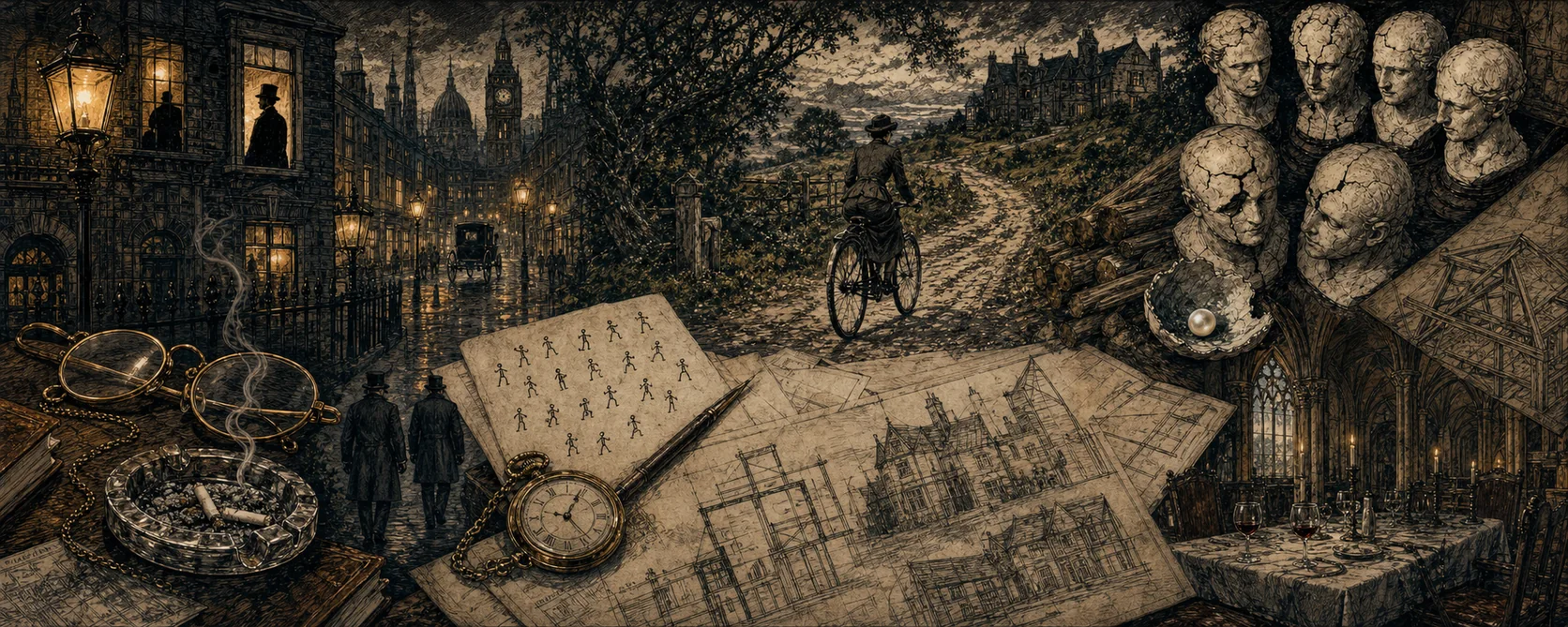
The Adventure of the Abbey Grange
Burglars supposedly kill Sir Eustace with a poker, but three wine glasses tell another story; Holmes convenes his own jury of one — Watson — and acquits.
✅ Public domain — read, share, and adapt freely.
⚠️ Spoilers below. The analysis discusses the solution, including who did it and how it's found out.
Summary & analysis
Lestrade summons Holmes to a burglary-murder: Sir Eustace Brackenstall killed with a poker, his young wife bound and terrorised, the Randall gang of three the obvious culprits by her account and her maid's.
The scene disagrees with the story: the bell-rope that supposedly bound her would have rung; three wine glasses hold beeswing in only one, as if a tidy pourer faked a third drinker; and the lady's bruises and calm ring false. Holmes reconstructs one man, not three.
Captain Croker, defending Lady Brackenstall from her brutal drunkard husband, killed him in a fair fight; she and the maid invented the burglars. Holmes empanels Watson as a jury of one, hears the case, and acquits — declining to hand a decent man to the law for ending a monster.
Deeper reading
Three glasses tell the truth
The Abbey Grange hinges on one of the canon\'s cleanest physical clues: three wine glasses, only two used and the third holding the dregs of beeswing, prove that the burglars\' story is a fabrication and only one man drank. Doyle builds the whole reconstruction from a detail a lesser eye would clear away, the observation-as-evidence method at its sharpest.
Holmes convenes his own court
The story\'s famous ending has Holmes appoint himself judge and Watson jury, and acquit a sympathetic killer of a brutal husband. It is the fullest expression of the detective\'s willingness to place justice above the law — he lets the guilty man go and takes the moral weight himself. Few stories state the canon\'s ethics so directly.
In the video game
Players often meet this case in Sherlock Holmes: Crimes & Punishments (Frogwares, 2014), which adapts it as The Abbey Grange Affair — and builds its signature mechanic on this very ending: after the deduction, the game hands you the choice the story gives Holmes, to condemn Captain Croker or absolve him. The conclusion is not a cutscene but a verdict, which is exactly Doyle\'s point.
Play this story
Free, built on this case's own facts — no sign-up, nothing to install.
Techniques on display
Elimination
Striking out the impossible until the truth remains.
In this story: The three-glasses tell: beeswing settles into only one glass, so the third was poured to fake a third guest — the burglary story collapses into a solo act.
Interrogation & deception
Testing stories for the thread that doesn't reach the wall.
In this story: Holmes catches the wife's rehearsed calm and the rope's un-rung silence, pressing the inconsistencies until the true, sympathetic story emerges.
Observation
Reading occupation, history, and character from visible detail.
In this story: The bruise pattern and the bloodstains map a single struggle, not a gang's ransack — physical evidence outvoting two matching testimonies.
Practise what this story preaches: every technique above links to a tool or game built on the same method. The best way to learn the canon is to reason along with it.